
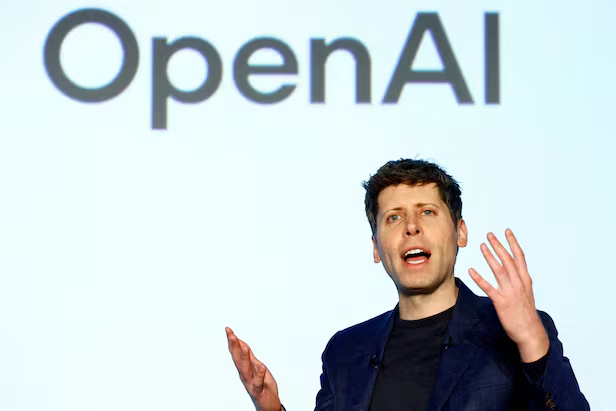
After years of requests from the developer community, OpenAI has finally released two open-weight models: gpt-oss-120B and gpt-oss-20B. This marks the company’s first open release of this kind since GPT-2 in 2019 — and it’s a huge deal for the open-source AI world.
What Did OpenAI Release?

- gpt-oss-120B: A powerful 117-billion-parameter model, comparable to OpenAI’s o4-mini. Best used on high-end systems with 80GB of GPU memory or more.
- gpt-oss-20B: A lightweight 21-billion-parameter model that runs well on consumer PCs with as little as 16GB of RAM — great for local deployment and tinkering.
Both models are released under the Apache 2.0 license, which means:
✅ Free for commercial use
✅ You can modify, redistribute, or fine-tune them
✅ Available now via Hugging Face, AWS, Azure, and other platforms
Why This Matters
This release is more than just technical — it’s a strategic shift. OpenAI is responding to the growing influence of open-source AI models like Meta’s Llama and Mistral. With these models, OpenAI is signaling its intent to re-engage with the open community and make powerful tools more accessible to developers, researchers, and businesses.
What Can These Models Do?
OpenAI claims the gpt-oss models are particularly strong in:
- Chain-of-thought reasoning
- Tool use (like calling APIs or running simple code)
- Question answering
- Text summarization
They don’t support images, video, or audio — they’re purely text-based.